 CORNERFLICK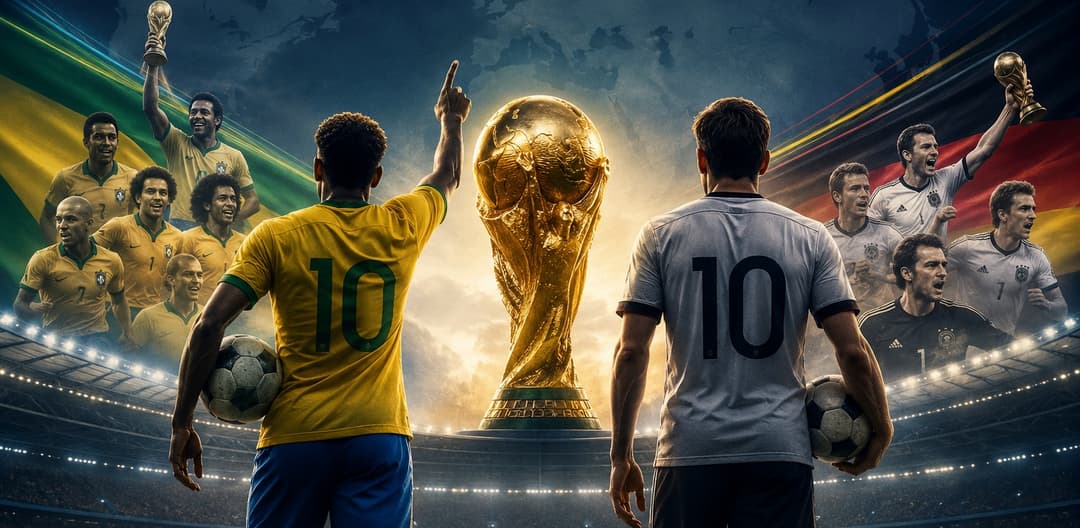
With more than 3,000 goals scored across nearly a century of FIFA World Cup history, the tournament's all-time scoring statistics offer more than just a record of goals—they provide a clear picture of how the balance of power in world football has evolved. The numbers show that Brazil and Germany remain, by a considerable margin, the most prolific teams in World Cup history, underlining the enduring dominance of two of the sport's traditional powerhouses.
Brazil tops the all-time scoring chart with 247 goals, accounting for 8.23% of every goal scored in World Cup history. Germany follows closely with 243 goals (8.10%), just four behind the five-time world champions. Argentina ranks third with 166 goals, followed by France (150), Italy (128), Spain (117), England (115), the Netherlands (107), Uruguay (92), while Sweden and Hungary share 87 goals each. Collectively, these 10 nations have scored more than half of all goals in World Cup history, with the remaining 48.7% spread across dozens of other participating countries.
Brazil's position at the top is no coincidence. The Seleção is the only nation to have qualified for every World Cup since the tournament began in 1930, giving it unparalleled opportunities to build its record. Combined with five world titles and generations of legendary players—including Pelé, Ronaldo, Ronaldinho, Kaká and Neymar—Brazil has consistently been one of the tournament's most attack-minded teams.
Germany's remarkable consistency has also been central to its success. With four World Cup titles, four runner-up finishes and regular appearances in the latter stages of the competition, Germany has established itself as one of the most reliable performers in World Cup history. Its historic 7-1 victory over Brazil in the 2014 semi-finals not only produced one of football's most memorable results but also helped narrow the gap between the two nations in the all-time scoring rankings.
The gap separating Brazil and Germany from the rest is not solely a reflection of their trophy counts. Their sustained success in reaching the knockout rounds has provided significantly more matches—and therefore more opportunities to score. By contrast, nations such as Sweden and Hungary, once among the world's elite during the 1950s and 1960s, have slipped down the historical rankings after failing to maintain regular deep runs in recent decades.
Meanwhile, countries such as France and Argentina have strengthened their positions in the modern era. France's World Cup triumphs in 1998 and 2018, along with runner-up finishes in 2006 and 2022, have elevated Les Bleus into the top tier of all-time scorers. Argentina, powered by successive generations of iconic players from Diego Maradona to Lionel Messi, has also consolidated its place among the tournament's most prolific teams while closing the gap on Brazil and Germany.
From a continental perspective, Europe holds the largest share of World Cup goals thanks to the depth of its elite nations. Germany, France, Italy, Spain, England and the Netherlands are all among the leading scorers, reflecting the continent's sustained strength over decades. South America's record, by comparison, relies heavily on Brazil and Argentina. Without those two giants, the continent's overall contribution would fall well behind Europe's, although Uruguay remains a reminder of South America's early dominance in the competition.
At the same time, nearly half of all World Cup goals have been scored by teams outside football's traditional elite. Nations including Croatia, Belgium, Portugal, Mexico, Japan, South Korea, Iran, Morocco, Senegal, Cameroon, the United States and many others have all contributed to the tournament's rich history. Continued investment in football across Asia, Africa and North America has gradually narrowed the gap between emerging nations and the established powers.
The expansion of the World Cup has also played a significant role in the growth of scoring records. What began as a 13-team tournament has evolved into a 48-team competition, creating substantially more matches and, consequently, more opportunities to score. As a result, many long-standing records are likely to be surpassed in future editions.
Despite these changes, the all-time statistics still underline the enduring dominance of Brazil and Germany. Their remarkable consistency, longevity and success have made them the benchmark for goalscoring excellence on football's biggest stage, even as the global game becomes increasingly competitive and more evenly balanced with each passing World Cup.